
Joe Carter
April 7, 2026
4 Modus Operandi: Why Most Businesses Fail at Execution
Strategy doesn’t fail because it’s wrong.
It fails because it’s not executed.
That’s the part most people don’t want to admit.
The plan is usually sound.
The direction makes sense.
But somewhere between intention and execution, things start to drift.
Priorities shift.
Follow-through weakens.
Results become inconsistent.
And over time, performance declines—not because the strategy was flawed, but because it was never fully implemented.
The Real Problem Isn’t Strategy—It’s Structure
Most businesses don’t lack ideas.
They lack structure around execution.
You’ll see it in how teams operate:
- Goals are set, but not tracked
- Metrics are reviewed, but not acted on
- Tasks are assigned, but not owned
From the outside, it looks like progress.
Internally, it’s fragmentation.
Andy Grove, former CEO of Intel, built one of the most operationally disciplined companies in the world by focusing on execution cadence—not just strategy. His principle was simple: what gets scheduled and reviewed gets done.
Most businesses don’t operate that way.
Why Execution Breaks Down
Execution fails in predictable patterns.
Not because people don’t care.
Because the system isn’t built to support it.
You’ll typically see three breakdowns:
1. Goals Without Tracking
Teams set targets.
Revenue goals. Growth targets. Operational improvements.
But there’s no consistent mechanism to track progress.
So goals become:
- quarterly conversations
- not weekly realities
Without visibility, there’s no correction.
And without correction, performance drifts.
2. Tracking Without Action
Some businesses do track metrics.
They have dashboards. Reports. Data.
But nothing happens with it.
Numbers get reviewed.
Then everyone goes back to operating the same way.
Peter Drucker’s often-quoted line—“what gets measured gets managed”—only holds if measurement leads to action.
Otherwise, it’s just reporting.
3. Action Without Accountability
This is where most execution actually fails.
Tasks get assigned.
But no one truly owns the outcome.
There’s no:
- follow-up
- consequence
- reinforcement
So execution becomes optional.
And optional execution leads to inconsistent results.
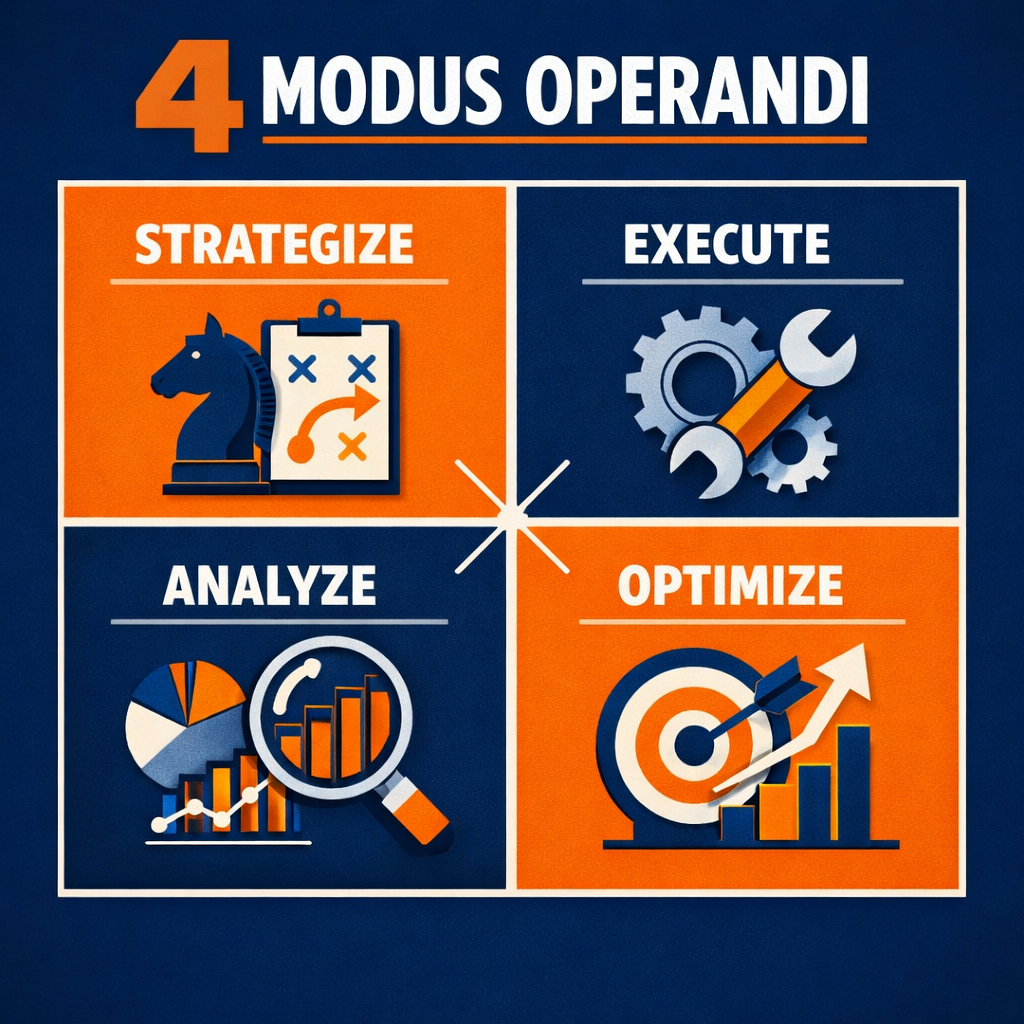
The 4 Modus Operandi: A Simple Execution System
The 4 Modus Operandi exists to fix that.
Not by adding complexity.
By creating structure.
Four components:
1. Clear Goals
Not broad direction.
Specific outcomes.
What exactly needs to be achieved?
Clarity removes ambiguity.
And ambiguity is one of the biggest killers of execution.
2. Measurable Milestones
Progress must be visible.
Not at the end of the quarter.
Weekly.
What are the indicators that things are moving in the right direction?
Without milestones, goals are just intentions.
3. Specific Actions
What is being done—this week—to move the business forward?
Not ideas.
Not discussions.
Actions.
Because execution lives in activity.
4. Weekly Accountability
This is the difference.
Everything gets reviewed.
Every week.
What was supposed to happen?
What actually happened?
Why?
And what changes next?
Jeff Bezos has spoken about the importance of operational cadence—regular, disciplined reviews that keep the business aligned. Without cadence, even strong teams lose focus.
Accountability creates that cadence.
Why Simplicity Works
The 4 Modus Operandi is simple.
That’s intentional.
Because most execution systems fail for the opposite reason.
They’re too complex.
Too many tools.
Too many layers.
Too many moving parts.
And as a result, no one follows them consistently.
Execution doesn’t require complexity.
It requires consistency.
What Happens Without This Structure
Without a defined execution system, businesses start to drift.
You’ll see:
- priorities constantly changing
- initiatives starting but not finishing
- teams operating without alignment
- performance becoming unpredictable
The business doesn’t stop.
It just stops improving.
And over time, that compounds.
What Happens When It’s Implemented
When execution is structured, something changes quickly.
Not over months.
Within weeks.
You get:
- clarity on what matters
- visibility into progress
- alignment across the team
- consistent follow-through
Decisions become easier.
Performance becomes more predictable.
And momentum builds.
Because the business is no longer relying on motivation.
It’s operating on structure.
Final Thought
Most businesses don’t fail because they lack strategy.
They fail because they lack execution discipline.
The gap between where a business is and where it could be is almost always execution.
Not ideas.
Not opportunity.
Execution.
The 4 Modus Operandi doesn’t introduce new strategy.
It ensures the existing strategy actually happens.
And in most cases, that’s the difference between a business that grows…
And one that consistently performs.
Joe Carter
Learn more about our founder Joe Carter, a nationally recognized business consultant and speaker.
Follow us on Linkedin.png)