
Joe Carter
April 9, 2026
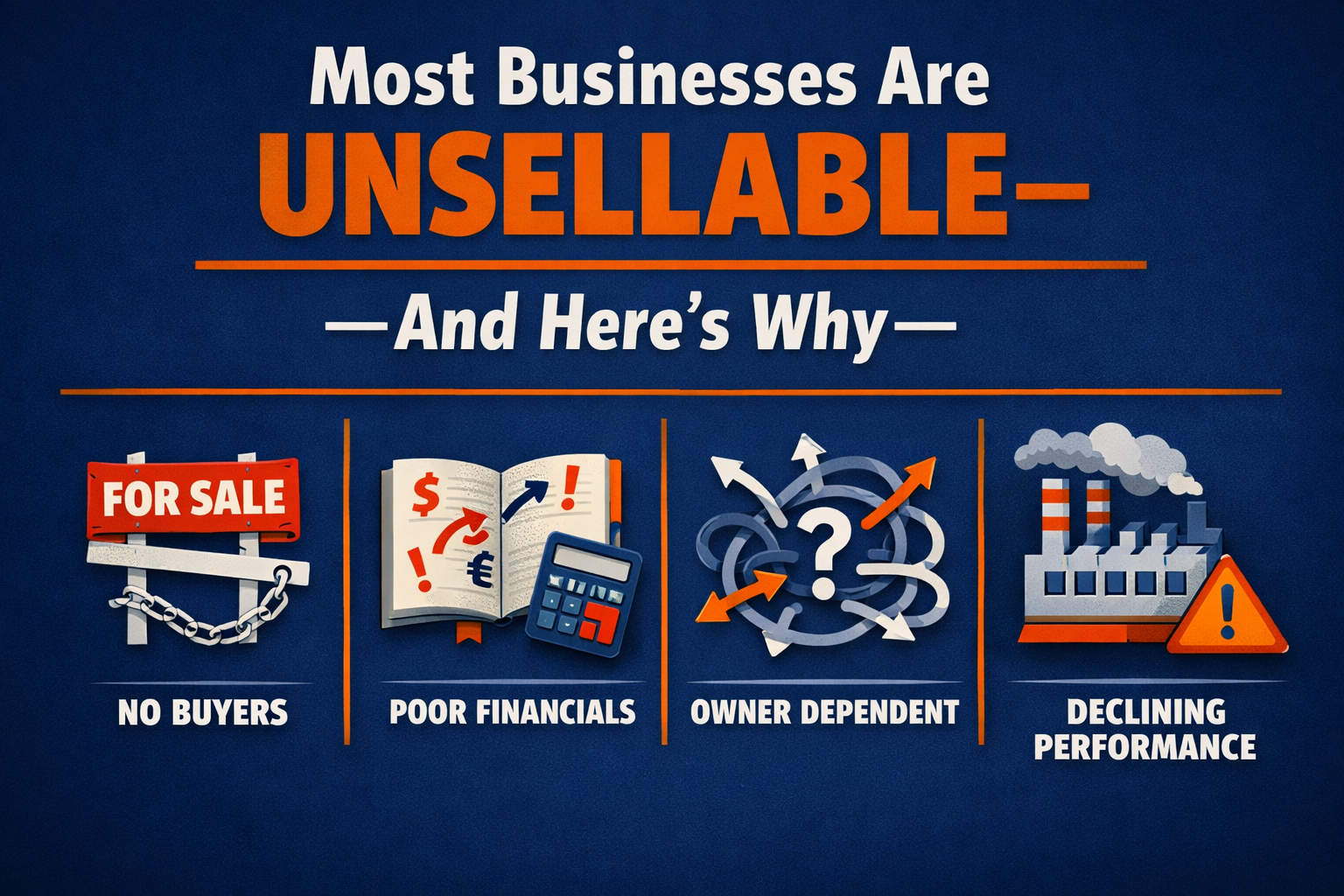
Most Businesses Are Unsellable—And Here’s Why
Most businesses aren’t unsellable because they’re bad businesses.
They’re unsellable because they’re built around the owner.
That’s a hard truth most operators don’t confront until they’re already trying to sell.
From the outside, everything can look solid.
Revenue is steady.
Customers are there.
The business is operating.
But once a buyer starts looking closer, a different picture emerges.
The Hidden Structure Behind Most Businesses
In many businesses, the real infrastructure isn’t systems.
It’s the owner.
Decisions run through one person.
Problems get escalated to one person.
Key relationships depend on one person.
That works—until that person steps out.
At that point, the business isn’t operating independently.
It’s being supported.
Michael Dell has spoken about building organizations that don’t rely on a single point of failure. The same principle applies here. If the business depends on one individual, it carries inherent risk.
And risk directly impacts value.
Why This Doesn’t Show Up Day to Day
Most owners don’t see this as a problem.
Because in daily operations, it isn’t.
Things get handled.
Decisions get made.
Revenue comes in.
The business functions.
But it functions because the owner is there to hold it together.
That distinction matters.
Because buyers aren’t evaluating how the business performs today.
They’re evaluating how it performs after ownership changes.
Where the Instability Comes From
When a business is built around the owner, several issues tend to exist beneath the surface:
- Decisions are centralized
There’s no clear structure for how decisions get made without the owner - Knowledge isn’t documented
Processes live in conversations, not systems - Performance isn’t clearly tracked
Metrics may exist, but they don’t drive operations
From the outside, none of this is obvious.
From a buyer’s perspective, it’s immediately visible.
And it creates uncertainty.
Why Buyers Walk Away—or Discount Heavily
Buyers are not just acquiring current performance.
They’re acquiring future performance.
So they ask a simple question:
What happens when the owner is no longer involved?
If the answer is unclear, the deal changes.
That shows up in three ways:
- lower valuation
- more conservative deal structure
- or the buyer walks entirely
Howard Marks has consistently emphasized that uncertainty—not just risk—drives investment decisions. In acquisitions, uncertainty shows up when a business cannot operate independently.
That’s what buyers are reacting to.
The Difference Between a Business and a Job
This is where the distinction becomes clear.
A business:
- operates through systems
- has defined roles and responsibilities
- produces consistent results without constant oversight
A job:
- depends on the owner’s involvement
- requires constant decision-making
- lacks structure behind execution
Many owners believe they have built a business.
In reality, they’ve built a high-performing job.
That’s not a criticism.
It’s just not transferable.
Why Revenue Doesn’t Fix This
Revenue can make a business look strong.
But it doesn’t solve structural problems.
A business can generate:
- significant top-line revenue
- strong customer demand
- steady activity
And still be unsellable.
Because revenue doesn’t remove dependency.
It often increases it.
As the business grows, so does the need for coordination, decision-making, and oversight.
Without systems, that burden falls back on the owner.
And that reinforces the problem.
What Makes a Business Transferable
For a business to be sellable, it has to operate without the person who built it.
That requires:
- Documented systems
So execution is consistent across people and locations - Clear KPIs
So performance is visible and measurable - Defined accountability
So outcomes are owned beyond the founder - Reduced owner involvement
So the business can function independently
Ray Dalio’s principle applies directly here: systems create consistency, not individuals.
That’s what buyers are looking for.
Why Most Owners Wait Too Long
Most owners don’t address this until they’re preparing to sell.
At that point, time becomes the constraint.
Because these aren’t quick fixes.
You can’t:
- document systems overnight
- build a leadership team instantly
- remove yourself from operations immediately
These are built over time.
And the earlier they’re addressed, the more options the owner has.
Final Thought
Most businesses aren’t unsellable because they lack revenue.
They’re unsellable because they lack independence.
They rely on the owner to:
- make decisions
- solve problems
- drive performance
And once that dependency is exposed, value drops.
Because buyers don’t want to acquire a role they have to fill.
They want to acquire a business that already works.
That’s the difference.
And that’s why most businesses never actually transfer.
Joe Carter
Learn more about our founder Joe Carter, a nationally recognized business consultant and speaker.
Follow us on Linkedin.png)